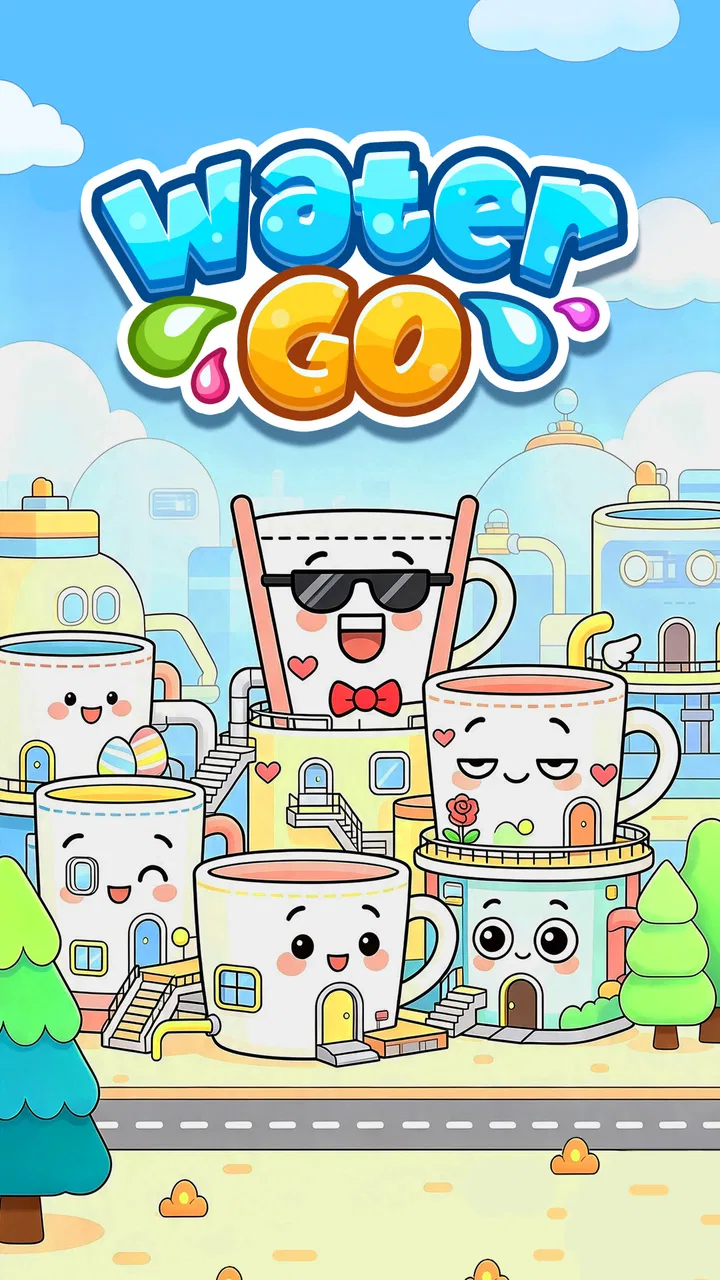
Water Go
- 4.9
- Rating
- 10.00K
- Installs
- Free
- Price
 Analysis by App-foxy
Water Go is the kind of strategy game that makes a strong first impression by asking for a simple physical action: draw. Its store summary, “Draw to play, play to earn!”, points toward an experience built around turning lines into decisions rather than tapping through a long menu of commands. I found that immediately appealing because the idea is easy to understand, yet drawing can create a surprising amount of room for planning, hesitation, and experimentation.
After spending time with it, my main takeaway is that Water Go is at its best when the act of drawing feels like the strategy itself. It is not trying to overwhelm the player with a large rulebook or a complicated interface. Instead, it creates a focused loop in which the shape, direction, and timing of a gesture matter. That makes it approachable for casual players, while still giving patient players a reason to look for better ways to act.
The game is free, and MicroSurge presents it as a strategy title for everyone. It has an average rating of 4.9 from around nine thousand ratings, with more than ten thousand installs, so there is already a clear sign that its compact concept connects with players. The current version is 1.0.2, and it runs on Android six or later. Those details make it easy to try on a wide range of phones without treating the game as a demanding premium production.
You May Also Like

 Blood Strike: 2.5 Anniversary
Blood Strike’s Loadouts Turn Every Drop Into a Tactical Gamble
A close look at Blood Strike’s custom loadouts: how fast access to signature weapons reshapes its battle royale rhythm, rewards preparation, and narrows the gap between fights.

 Pandora - Music & Podcasts
Pandora’s Music Is Easy to Start, but Harder to Recover
Pandora’s strength is its low-effort path from a seed to a station. Its weak spot is how much confidence it asks you to place in connection, setup, and quiet recovery.

 8 Ball Pool
 Is Built on Rivalries, Rematches, and Routine
A close look at the rivalries, rematches, shared routines, and unanswered safety questions that turn a quick pool match into a persistent mobile community.

 Samsung Music
’s Quiet Strength Is Playing What You Already Own
Its reach comes less from spectacle than from dependable access to a personal library. That simplicity is both the app’s strongest retention engine and its ceiling.

 AccuWeather: Weather Radar
AccuWeather Review: A Quick, Clear Forecast for Everyday Decisions
For everyday plans, the best forecast is the one you can understand quickly. AccuWeather makes rain timing, radar, and local conditions easy to act on, with a few trade-offs.

 Hill Climb Racing
Why Hill Climb Racing Still Turns Crashes Into One More Run
A tiny car, a bumpy hill and one more upgrade: Hill Climb Racing keeps resurfacing because its simple chaos makes every near-miss feel personal.
More From Our News Desk
View All News


A simple gesture that needs a thoughtful player
My first impression was shaped by the contrast between the small premise and the decisions hidden inside it. Drawing sounds less formal than selecting a unit, placing a building, or opening a tactical command screen. Yet a gesture can still carry intent. A quick line may be useful when speed matters, while a more carefully considered path can be better when the board punishes waste or poor positioning.
That difference is important. Water Go does not seem designed around the usual strategy-game fantasy of controlling a huge map from above. Its appeal comes from making the player physically express a plan. I am not simply choosing an option from a list; I am trying to make the right mark in the right place. That gives each action a more personal quality, even when the underlying rules remain straightforward.
The low barrier to entry is one of the game’s strongest qualities. Someone who normally avoids strategy games can understand the basic invitation quickly: draw, observe the result, and adapt. There is no need to learn a large collection of character abilities before making a meaningful move. This makes it a good choice for short sessions, especially when I want something interactive but do not have the time or patience for a long campaign.
At the same time, the simplicity creates a responsibility for the player. If you enjoy strategy mainly because of deep progression trees, extensive customization, or a large variety of units, this may feel too narrow. Water Go’s interest comes from refining the gesture and reading the situation, not from collecting a huge toolbox. I would recommend it to someone who enjoys compact tactical puzzles more readily than someone looking for a full-scale empire-building game.
How the visual language supports the setting
The water-focused identity gives the game a clear artistic direction. Even without relying on a crowded fantasy setting or a heavy science-fiction explanation, the theme suggests movement, flow, connection, and changing routes. That is useful because the visual idea and the central interaction point in the same direction: the player draws, and the drawn path becomes part of the action.
When a game is built around lines, the visual presentation has to make those lines readable. I paid attention to whether the eye could follow the result of a gesture and understand what had changed. That clarity matters more here than decorative detail. A beautiful background would not help if the important route or consequence disappeared into it. Water Go works best when its presentation keeps attention on the relationship between the drawing and the board.
The setting also gives the game a calmer identity than many strategy alternatives. Traditional strategy games often use military maps, bright combat effects, or crowded interfaces to communicate urgency. Water Go can create a more meditative mood by letting the player think in terms of flow rather than confrontation. That does not remove the need for decisions, but it changes how those decisions feel.
One useful way to approach the game is to treat every drawing as a piece of visual planning. Before touching the screen, I look for the direction that seems most natural, then consider whether a shorter or more deliberate line would produce a cleaner result. This habit is more valuable than drawing quickly just because the gesture is easy. The game rewards attention to the shape of a solution, not only the fact that a solution exists.
That is also where the art direction and mechanics meet. The water theme is not merely a label placed over a generic strategy system. It gives the player a mental model for thinking: avoid unnecessary obstruction, search for a useful route, and consider how one movement may influence the next. I find that kind of visual metaphor helpful because it lets me understand the game intuitively before I have fully analyzed its rules.
Sound, rhythm, and the feeling of each move
Sound has a difficult job in a minimalist strategy game. If it is too loud or too aggressive, it can fight against the thoughtful pace created by drawing. If it is too quiet or repetitive, the actions may feel disconnected. In Water Go, the most effective rhythm comes from allowing the player to move between observation and action: inspect the situation, draw, register the result, and prepare for the next decision.
I prefer playing this kind of game when the audio supports concentration instead of demanding attention. The water-centered mood benefits from restraint. A player should feel that the board is responding to a gesture, not that every small action has been turned into an exaggerated event. That balance helps the game remain suitable for relaxed sessions, including moments when I am playing alone and want something mentally engaging without a stressful atmosphere.
The rhythm also affects how I judge mistakes. In a fast arcade game, an error can feel like a reflex failure. In a drawing-based strategy game, it feels more like a planning error. That distinction makes me pause and review what I was trying to accomplish. If I drew too soon, used an awkward route, or failed to consider the next position, the lesson is understandable and immediately useful.
There is a practical tip here that generic descriptions rarely explain: do not treat every turn as a race to place a mark. I get better results when I use the moment before drawing to identify the intended endpoint and the likely consequence. That small pause improves both accuracy and rhythm. It also keeps the atmosphere coherent, because the game feels like a calm decision-making space rather than a frantic test of touchscreen speed.
Players who want constant action may find this pacing slow. That is not necessarily a flaw, but it is a clear trade-off. Water Go’s mood depends on giving gestures room to matter. If you prefer strategy games with rapid attacks, frequent interruptions, and a strong sense of escalation, a more conventional real-time title may suit you better.
Why the drawing mechanic fits the strategy category
The central mechanic works because it connects intention with execution. In many strategy games, the player chooses an action and watches an avatar or unit perform it. Here, the action is more direct. The line I draw is the decision I am making. That makes small differences in angle, length, and placement feel meaningful, even when the overall rules are easy to grasp.
This approach has a useful advantage on a phone. Touch controls can sometimes make traditional strategy interfaces feel cramped, especially when a game expects precise selection among many small buttons. A drawing interaction uses the screen more naturally. I can focus on the active area instead of searching through several layers of controls. For a mobile game, that is a sensible design choice.
It also changes how replayable the experience feels. A conventional puzzle may have one obvious correct answer, while a drawing system can invite experimentation with different approaches. I enjoy testing whether a cleaner line, a different starting point, or a more patient sequence produces a better outcome. That kind of replay value comes from improving my understanding rather than simply unlocking more content.
One of the more useful advanced habits is to separate “possible” from “efficient.” A drawing may technically solve the immediate problem while creating a worse position afterward. I try to judge each gesture on two levels: does it work now, and does it leave room for the next decision? That second question is where the strategy becomes more interesting. It encourages planning ahead without requiring a complicated interface.
Another practical insight is to use the visual space deliberately. When a game asks me to draw, I naturally want to begin wherever my finger happens to be. Instead, I first identify the cleanest starting area and imagine the full motion. This reduces accidental curves and makes the result easier to interpret. On a smaller phone screen, that preparation is especially helpful because a rushed gesture can obscure the very information I need to read.
The touch-first design is not perfect for everyone. Players with limited screen space, older devices, or a preference for physical controls may find drawing less comfortable than tapping. Precision can also become a source of friction if the player expects the game to interpret every gesture exactly as intended. I would not choose Water Go as my main strategy game if I wanted the certainty and complexity of mouse-based control.
Where it fits into everyday play
I can easily imagine using Water Go during a short break when I want a game that engages my attention without requiring a large commitment. The free price makes that decision simple: there is no need to plan around a purchase before discovering whether the drawing mechanic suits me. The Everyone content rating also makes it a broadly approachable option for households where a game needs to remain suitable for a wide age range.
A realistic session might begin while waiting for an appointment. I open the game expecting to make a few quick moves, but a difficult situation encourages me to slow down and test a more careful route. Because the core action is compact, I can stop after a short attempt without feeling that I have abandoned a long mission. If I have more time, I can return to the same kind of challenge with a better understanding of what went wrong.
That flexibility is one of its strongest everyday qualities. Water Go does not need to replace a large strategy game; it works as a smaller companion for moments when I want planning in a concentrated form. It is also a reasonable introduction for a friend who says strategy games are too complicated. I can explain the basic interaction quickly, then let the person learn through the relationship between a gesture and its outcome.
The game is less suitable for players who need a persistent story, a large cast, or a long-term management system. It also may not satisfy someone who measures value by the amount of content rather than the quality of a focused mechanic. In those cases, a traditional turn-based strategy game would offer more variety and a stronger sense of progression, while a puzzle game with fixed solutions might provide more predictable structure.
For younger or less experienced players, the drawing interaction can make the strategy feel less intimidating. An adult can demonstrate the idea without explaining a large set of rules, and the player can learn by watching how different lines behave. That said, I would still encourage a new player to slow down rather than assume that the easiest-looking drawing is always the best one. The game’s charm grows when the player begins to think about consequences.
What the latest version means for new players
New players are joining a relatively early version of the experience. MicroSurge lists the current release as 1.0.2, which gives the game a clear sense of being a compact product rather than a sprawling platform that has accumulated years of systems. I see that as both an advantage and a limitation: the design feels focused, but players seeking a deep ecosystem should set their expectations accordingly.
The Android requirement of six or later is modest enough to make the game accessible on many devices. Still, the quality of a drawing game depends on how comfortably the screen responds to touch, so I would pay attention to the physical experience of playing on your particular phone. A game can be strategically sound and still feel less enjoyable if the display is cramped or your finger regularly covers the active area.
The free model is helpful for trying the concept, but it also means I judge the game primarily by how satisfying the central loop is. If drawing, observing, and refining a plan already feels rewarding, Water Go has a reason to stay installed. If you need a large amount of variety before a game earns your time, the focused design may feel limited even though the entry cost is low.
The public response is encouraging, with around nine thousand ratings averaging 4.9, while the review count sits at only a small handful. I read that combination as a sign of strong initial approval rather than proof that every type of player will enjoy it. The install total is over ten thousand, which places it in the category of a growing mobile game rather than a universally established strategy staple.
The atmosphere verdict: calm, clear, and deliberately compact
Water Go succeeds when its art direction, sound, setting, and pacing all support the same idea: strategy can emerge from a simple flowing gesture. The water theme gives the game an identity, the drawing mechanic makes that identity playable, and the measured rhythm gives the player time to think. I appreciate that coherence because it makes the experience feel designed around one central thought instead of assembled from unrelated features.
My strongest recommendation is for players who enjoy short tactical challenges, touch-based experimentation, and games that reward a second attempt. It is especially well suited to someone who likes discovering a better route after an imperfect first try. The most satisfying moments come from recognizing that a small change in the drawing can improve the whole sequence.
I would skip it if your ideal strategy game requires extensive armies, detailed resource management, competitive depth, or a dramatic campaign. Water Go is not trying to be that. Its value is narrower and more immediate: it turns drawing into a decision, then asks me to become more deliberate with each attempt.
In the end, I found the game easy to recommend as a free, approachable experiment with a distinctive mood. The best way to play is to resist rushing, study the available space, and think one move beyond the line under your finger. If you enjoy strategy that feels tactile, quiet, and focused, Water Go is worth giving a thoughtful try.
MicroSurge has built something that is small in scope but clear in personality. The experience does not need a complicated world to communicate its purpose. It uses water, movement, and drawing as parts of one coherent language, and that is why Water Go remains memorable after the first few gestures.
FAQs for Water Go
01What is Water Go, and how does it work?
Water Go is a hydration-tracking app designed to help you remember to drink water throughout the day. After entering information such as your body details, daily routine, activity level, and personal goals, the app can suggest a drinking target and schedule reminders. Its main purpose is to make hydration easier to monitor, although recommendations should be treated as general guidance rather than professional medical advice.
02Can I customize my water intake goal and reminders in Water Go?
Yes, Water Go is intended to let users adjust their hydration target and reminder schedule according to their lifestyle. You can typically record different amounts of water, change notification intervals, and adapt the plan to work, exercise, sleep, or travel routines. This flexibility is useful because a fixed reminder pattern may not suit everyone, especially users with unusual schedules or changing daily activity.
03Does Water Go support drinks other than plain water?
Water Go may allow users to log beverages in addition to standard glasses or bottles of water, depending on the version and device. However, not every drink hydrates the body in exactly the same way, and beverages containing caffeine, sugar, or alcohol should not automatically be considered equivalent to water. Review the available drink options carefully and use the app as a tracking aid, not as a nutritional authority.
04Does Water Go require an internet connection or create an account?
The exact requirements can vary between Android and iOS versions, as well as between app updates. Basic logging and reminders may work without a constant internet connection, while synchronization, backups, advertisements, or certain account-based features could require connectivity. Before relying on the app for long-term records, check its current permissions, privacy policy, and whether your data can be restored after changing or resetting your device.
05Is Water Go suitable for everyone, including people with medical conditions?
Water Go can be useful for healthy adults who simply want help building a regular drinking habit, but its suggested goals are not suitable for every person. People with kidney, heart, liver, or other medical conditions, as well as pregnant users, children, or anyone following fluid restrictions, should consult a qualified healthcare professional first. Do not use the app to override medical instructions or force excessive water consumption.
Pros
- Simple water-intake tracking with quick logging options.
- Helpful reminders can encourage more consistent hydration habits.
- Clean interface makes daily progress easy to understand.
- Supports personal goals based on your routine and needs.
- Useful history view helps identify hydration patterns over time.
Cons
- Reminder timing may need frequent adjustment for changing schedules.
- Manual logging can become repetitive during busy days.
- Some features may be limited without an internet connection.
- Notifications could feel excessive if goals are set too aggressively.
- Accuracy depends on consistently recording every drink consumed.

Water Go
Gallery